

As an undergraduate student at the School, Camilo Jaramillo’s academic career was marked by his work as a teaching assistant and research assistant in microeconomics with professors Jorge Rivera, Andrés Gómez-Lobo, and Dante Contreras; later, while pursuing his Master in Economics, he worked closely with Professor Marcelo Olivares, with whom he had the opportunity to learn about empirical industrial organization methods. His further specialization in microeconomic theory came through two professors whom he considers his mentors: Juan Escobar (CEA) and Juan Pablo Torres-Martínez, the latter serving as his advisor in the Master’s program and co-authoring an article published in the academic journal Games and Economic Behavior.
Specialization in market design
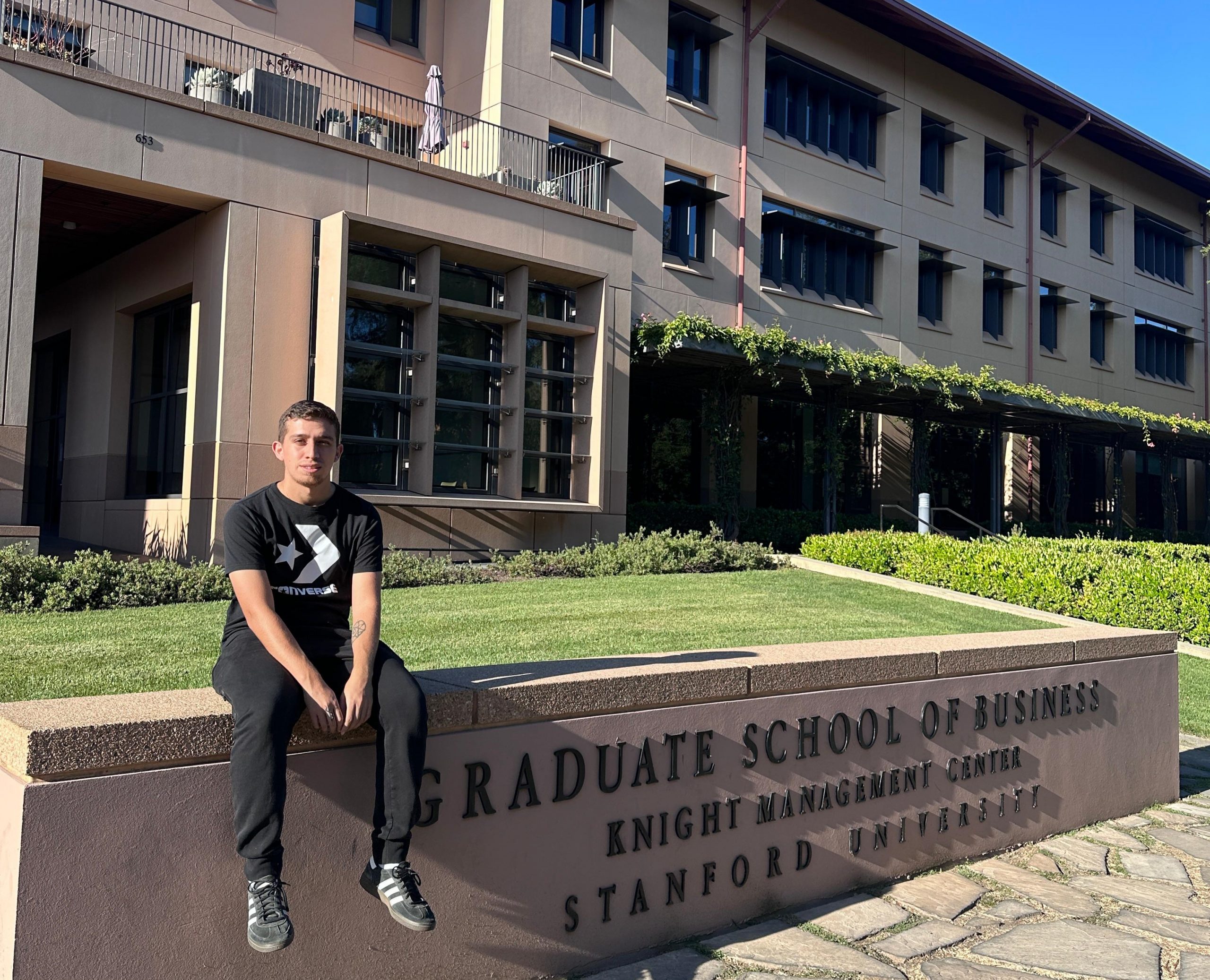
Upon graduating from the Master in Economics in 2024, Jaramillo completed a predoctoral fellowship at Stanford University, where he had the opportunity to work with researcher Claudia Allende in the empirical area of market design. During this period, he actively collaborated on the research paper Competition under social interactions and the design of education policies, a working paper focused on analyzing how preferences regarding classmates’ characteristics influence students in the long term.
On an academic and professional level, that experience allowed him to master advanced empirical methods, adapt to the demanding pace of research at a top-tier institution, and, most importantly, take the step into the PhD program at one of the world’s most prestigious institutions.
Currently, Camilo is settled at UC Berkeley, where he has focused on theoretical microeconomics, specifically on mechanism and market design. His interest lies in studying how different agent behaviors affect the functioning of allocation mechanisms. For that reason, he is already working with Jiarui Xie, a PhD student at Stanford, on a project aimed at comparing mechanisms in terms of how transparent they are to those who use them.
Along those lines, the publication of his article Minimizing manipulation in matching markets without outside options—based on his graduate thesis—in the latest issue of the journal Social Choice and Welfare reinforces the path he is forging.
Finally, when evaluating his academic experience, Jaramillo highlights the strength of the training received in both the undergraduate and graduate programs at FEN: “While the predoctorate helped me better understand how research works and acquire new tools that I will potentially use in my own research, the Master in Economics gave me a solid enough preparation so that the first year of the PhD feels largely like a review of what was covered in the ME. This has been excellent, as it has allowed me to delve deeper into the areas that interest me most and mature concepts I was already familiar with.”
Looking to the future, his goals are set on the academic field and on maintaining a continuous connection with the institution that trained him.